The Road to Makkah, My First Umrah and the Hijab in the Mataf
In Indonesia, Umrah is a once-in-a-lifetime dream. People save for a long time. Lots of people wait until their hair is gray and their hearts are settled. They wait until they are “ready.”
But there I was in 2005. Twenty-four years old. Newly married. Carrying my first child.
We weren’t flying across oceans to find the House of Allah. We were driving toward it from Riyadh.
The Quiet in the Desert
It was April or May—that fleeting, golden window before the Saudi summer turns the world into a furnace.
We left Riyadh late, after my husband finished work, chasing the horizon into an eight-hour drive. I remember the thrill of highways of Saudi Arabia which are very different from highways back home in Indonesia. And then, I remember the silence.
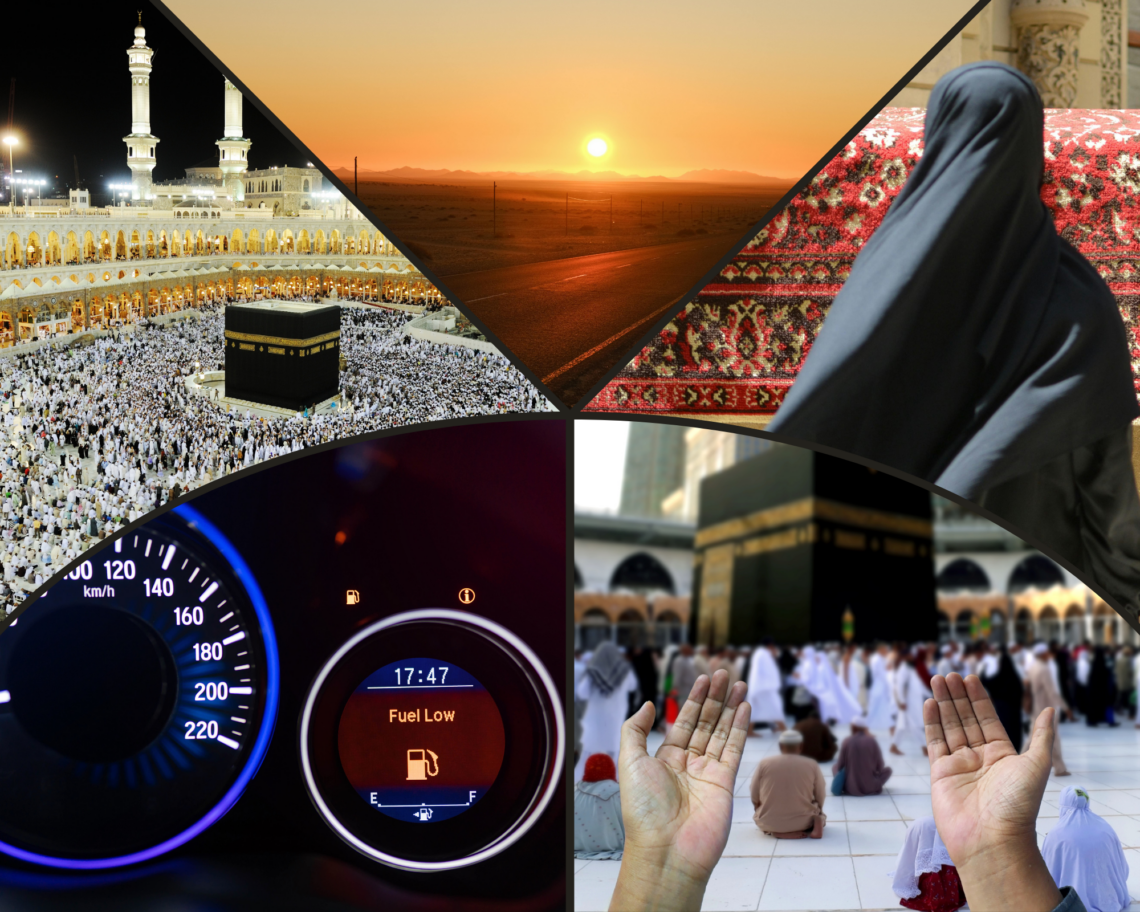
There is a stretch of road between Riyadh and Makkah that feels like a physical void. Somewhere in that darkness, the fuel light came on.
The “E” began to blink.
We can laugh about it now, but at that moment, the car felt suddenly and unnervingly quiet. We stopped talking, and even the hum of the engine seemed too loud, a fragile sound against the vastness of the desert. We both sat there, staring at the dark road, whispering duaa—not the loud, formal kind, but the desperate, rhythmic kind that comes from deep in the throat.
Please… just let us reach the next gas station. Just a little further.
In that heavy silence, I realized something: Umrah doesn’t begin at the Kaaba. It begins in the moment you realize how little control you actually have.
When the glow of a gas station finally flickered on the horizon, the relief was physical. A small mercy, arriving just before the great one.
The Midnight Arrival
We reached the Miqat at Sayl al-Kabir under a sky thick with stars. By the time we pulled into Makkah, it was nearly midnight.
The Makkah of 2005 was less developed. It was still magnificent, maashaa Allaah, but definitely not like what it is today. We stayed in Ajyad area, a hilly area, a bit messy, and loud.
Honestly, I didn’t feel the eight-hour drive. I didn’t feel the weight of the pregnancy. We moved through Tawaf and Sa’i in the cool stillness of the night. With a crowd, but I remembered it as being peaceful. A young couple, beginning a life we didn’t yet understand, at the center of the world.
Afterward, the small rituals: we get to pray right behind Maqam Ibrahim, then drank some Zamzam water, poured some on top of my hijab (I didn’t really remember why, but I did it). Then, we walked back to the hotel. I cut a lock of my hair in the room, and took a shower. My husband found a barber to shave his head. And then, we ate. Chicken and rice. Simple. Warm. It tasted like arrival. It tasted like gratitude.
The Shock in the Mataf
The next day, the sun was high and the Haram was humming with life. I was still floating in that spiritual “cloud,” certain that I was in a place where only the holy existed. I think it was after Jumuah prayer, if my memory is right.
Then, a scream shattered the peace.
“Haramiya! Haramiya!” (Thief! Thief!)
A woman in an abaya and niqab was sprinting through the crowd, chasing another woman—a pickpocket. The chase spilled right into the Mataf, the white marble area surrounding the Kaaba.
A circle of men began to close in on the thief. Seeing she was trapped, the pickpocket did something I never expected: She ripped off her own hijab and niqab.
She stood there, exposed and defiant. It was a calculated move. She knew the cultural weight of her own modesty; the men froze instantly, refusing to touch a woman whose face was uncovered until the shurtah (police) arrived.
I stood there, breathless.
I had imagined the Haram as a sanctuary untouched by the “real world.” I thought everyone on those white tiles was there only to weep and seek. Seeing a theft in the shadow of the Kaaba was a sharp, cold awakening: The Haram is a sanctuary, but it is still filled with humanity.
The Lesson of the Sacred and the Real
That journey didn’t give me a perfect experience. It gave me something much more valuable: it grounded my faith.
It showed me that you can stand in the holiest place on earth, carrying a new life, feeling the peak of spiritual ecstasy—and still witness the messiness of the human condition right next to you.
It didn’t take away from the barakah; it defined it.
I learned that barakah is not found in a life where nothing goes wrong. It is found in the ability to hold your center—whether you are on a dark road with an empty tank, or in the middle of a crowded Mataf when the world doesn’t look the way you imagined it would.
Have you ever had a “reality check” in a place you thought was perfect?
Sometimes the deepest reminders come not from the perfection we expect, but from the reality we encounter. I’d love to hear about a time when your faith met the “real world” and came out stronger for it.


You May Also Like
Faith Is Also Built on Ordinary Tuesdays
The Eid Al-Adha 2026 Allah Chose for Me