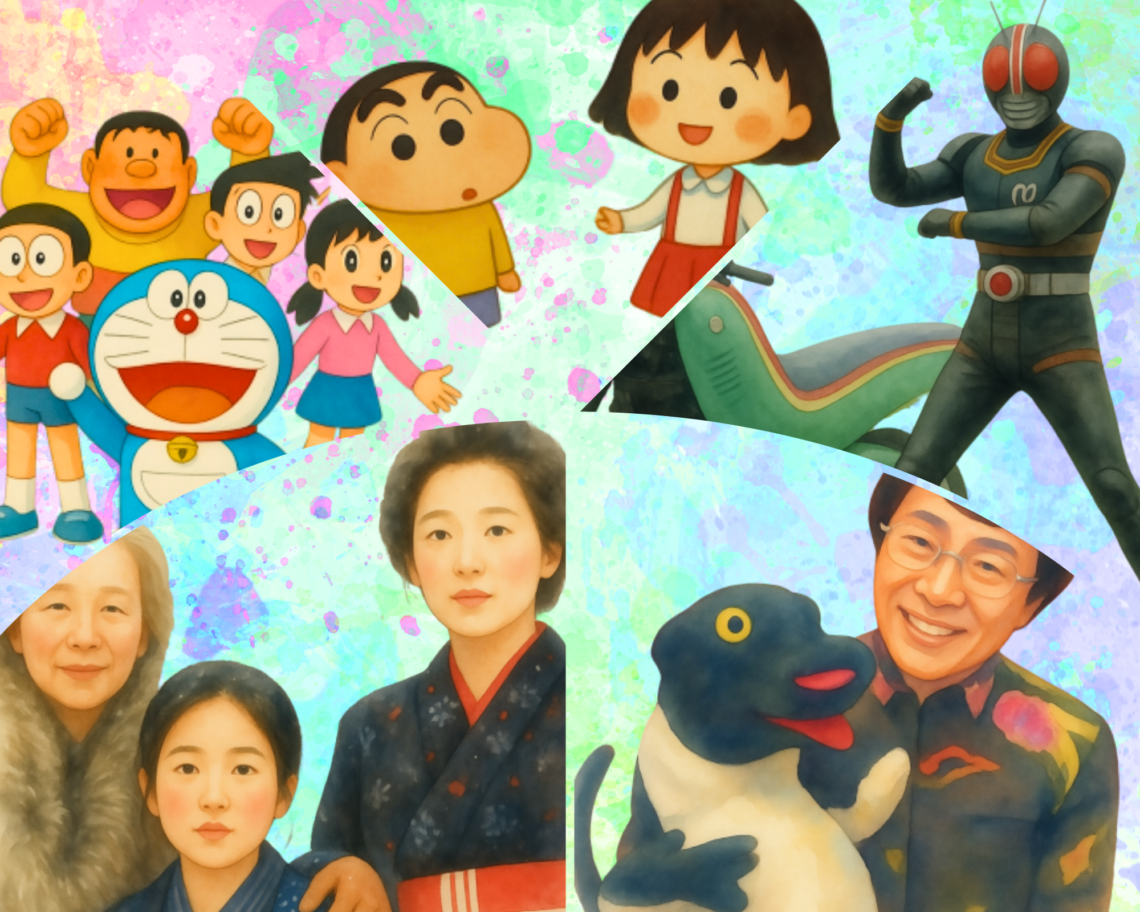
My TV Memory Lane, from Oshin to Si Komo
Memory is a funny thing. When I look back at my childhood in Indonesia, I often lump all my favorite shows into one giant, sunny morning. But if I’m being honest, they didn’t all happen at once. They were a patchwork—some were for Sunday mornings, some were for rainy Tuesday afternoons, some for those times after school, and others were the quiet, heavy dramas we watched with our parents in the evening.
They didn’t just occupy a timeslot; they occupied different seasons of my soul.
Oshin Taught Me About The Lessons of Resilience:
If I think about my very first “telenovela” experience, it wasn’t a glitzy soap opera. It was Oshin.
I remember the silence in the room when she was on screen. Watching her journey from a young girl in the snow to a resilient woman was a masterclass in endurance. Long before I knew what a “mental load” or a “crowded mind” was, I watched Oshin carry the weight of her world with a quiet, fierce dignity. She taught us that life is hard, but the spirit is harder. In many ways, she was an early mirror for the kind of strength we strive for as mothers—the ability to keep walking, even when the wind is against us.
The Daily Rhythms
Alongside the weight of Oshin, there were the lighter daily staples.
Doraemon and Hamtaro were the companions of our weekday afternoons, helping us unwind after school. We found pieces of our own childhoods in the animated antics of Chibi Maruko-chan and Crayon Shin-chan, shows that were always there when we needed to see the world through a child’s eyes again.
And then, the action. The undisputed king of my childhood adrenaline was Ksatria Baja Hitam (Kamen Rider Black). Whether he arrived on a Sunday or a weekday, the feeling was the same. The theme songs from Goggle V and the Power Rangers meant the world was simple, the villains were clear, and justice was always just one “henshin” away.
The Voices That Stayed
Some memories aren’t tied to an action hero, but to the gentle voices that mentored our imaginations.
Pak Tino Sidin was a constant across the years. I can still see him in his beret, tilting his head at a child’s drawing and saying: “Bagus… ya, bagus.” He didn’t demand perfection; he celebrated the attempt. He taught us that a few simple lines could create an entire world.
Then there was the duo that defined a generation’s kindness: Kak Seto and Si Komo. Kak Seto, with his soft voice and signature hair, was the adult who actually listened to us. And Si Komo, the friendly dragon, was our companion in the streets of Jakarta. Whenever the traffic was at a standstill, we sang along to “Macet lagi, macet lagi… gara-gara Si Komo lewat.” Between Kak Seto’s advocacy and Si Komo’s songs, we felt seen and understood in a world that was often too busy for children.
Passing on the “Bagus”
Today, my ten children live in a world of infinite choice. They don’t have to wait a week for a hero to appear or sit through the heavy silence of a drama like Oshin. They have everything at their fingertips, yet I find myself trying to recreate the feeling of those old memories for them.
It’s not about the shows themselves. It’s about the nasi goreng on the table. It’s about the way I try to channel Pak Tino Sidin when I look at their messy drawings and tell them, “Bagus… ya, bagus,” even when the house is in chaos.
I want them to have their own “sanctuaries”—not just on a screen, but in the rhythm of our home. I want them to know that even when the “traffic” of life is heavy (like a Si Komo roadblock), we can still find a song to sing. We might be in the UAE, far from the Jakarta of my childhood, but the heart of those memories—the patience, the resilience, and the simple joy—is something I’m still serving up every morning.
🌿 A Gentle Reflection
Did you grow up with Kak Seto or Oshin, too?
Whether it was Oshin’s quiet strength or the “Bagus!” of Pak Tino Sidin, what is the one show that taught you about life before you were even grown? I’d love to hear about your own tangled timeline of memories.


You May Also Like
The Forty Days Postpartum Rest We Forgot

The Quiet Vulnerability of Financial Dependence