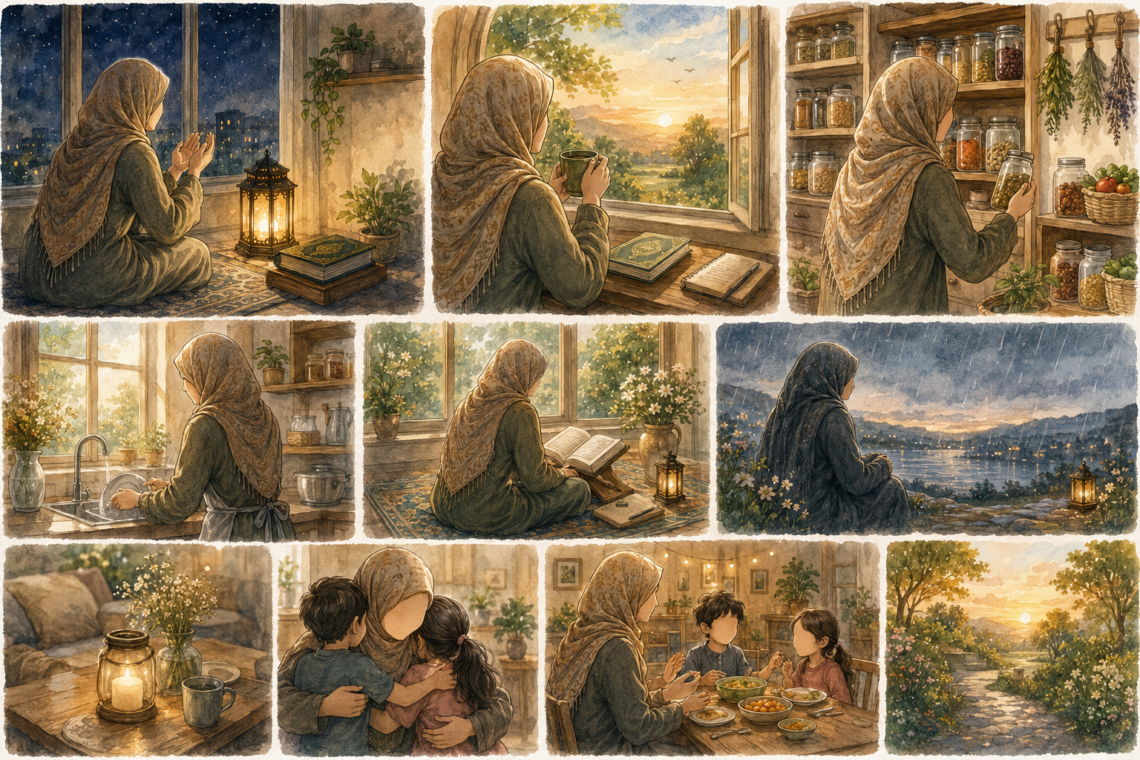
After Allah Answers the Du’a
There was a time when every du’a felt urgent.
I prayed for healthy children. I prayed for enough money to pay the bills on time. I prayed for difficult conversations to soften, and for illnesses to pass. I prayed for Allah to simply make life a little lighter, as though my heart was constantly leaning against a heavy door, trying to hold it shut. My prayers in those seasons were raw, frequent, and fueled by a deep, instinctive awareness that I had absolutely nowhere else to turn.
Looking back now, I can see that Allah answered so many of those prayers.
Not all at once, and perhaps not always in the exact shape I expected. But slowly, quietly, almost without me noticing, the fever finally broke. The baby began sleeping through the night. The difficult season ended. The exam was passed. The marriage survived.
Somewhere along the way, I quietly began living as though the difficult chapter had ended. I never said it out loud, but I think part of me believed that answered du’as meant I could finally relax. I assumed the trial was over, and the reward had begun.
It never occurred to me that an answered prayer might mark the beginning of a completely different kind of test.
Not a test of endurance, but a test of remembrance.
The Flattery of Ease
We are deeply conditioned to recognize the test of hardship because pain leaves us little choice. When everything is falling apart, turning to Allah becomes almost instinctive. Desperation pulls us to our knees, and we feel our poverty before Him in every fiber of our being.
But ease operates differently.
It doesn’t break the spirit.
It simply lulls it to sleep.
It happens one comfortable day at a time.
The pantry is finally full. The bills are paid. Nobody is sick this week, and you have an evening with nothing urgent demanding your attention. The house feels peaceful. Your heart finally exhales.
It feels like you’ve reached the finish line.
But perhaps this is precisely where another test begins.
Ease flatters us.
It tells us we earned this.
It tells us we are finally in control.
It tells us we can stop asking with the same desperation we once did.
It tells us tomorrow will probably look just like today.
Until one day, we realize we’ve become comfortable enough to forget our total, moment-by-moment dependence on Allah.
Not because we stopped believing.
Simply because we stopped needing Him in the same obvious way.
Hardship has a way of reminding us that we are servants. Comfort quietly tempts us to imagine we are self-sufficient. Our scholars have long observed that hardship often drives people back to Allah, while comfort can quietly distract the heart from remembering Him. That is why seasons of well-being deserve just as much vigilance as seasons of difficulty.
Remaining Awake
Perhaps the greatest patience in times of ease is simply continuing to feel your need for Allah.
It is making du’a when nothing is wrong.
It is thanking Him before another blessing arrives.
It is opening the Qur’an on an ordinary Tuesday afternoon without waiting for your heart to break first.
The Prophet ﷺ said:
“Whoever loves that Allah should answer him during times of hardship and grief, let him increase his supplication during times of ease.”
The heart that remembers Allah only in hardship has learned dependence.
The heart that remembers Him in ease has learned love.
To practice ṣabr when life is smooth means praying with a heart full of gratitude instead of desperation. It means looking at a peaceful home and quietly saying,
“Just because I don’t feel the storm today doesn’t mean I am the one holding the sky up.”
It means remembering that every ordinary Tuesday is held together by Allah’s mercy just as much as your hardest Monday ever was.
Allah reminds us:
“And [remember] when your Lord proclaimed: ‘If you are grateful, I will surely increase you; but if you are ungrateful, indeed, My punishment is severe.'” (Qur’an 14:7)
Gratitude is not merely the response to an answered prayer. It is one of the ways Allah preserves our hearts after the prayer has been answered. Perhaps the greatest increase promised in this verse is not always more possessions or more comfort, but a heart that continues to remember its Lord.
Every blessing quietly holds up a mirror to our hearts and asks a question:
“Will this gift bring you closer to the One who sent it… or will it slowly occupy the place where only He belongs?”
True sincerity is often revealed after the crisis has passed.
The real test of love is not only whether we cry out to Allah when we are drowning.
It is whether we continue turning to Him when we are finally standing on dry ground.
Two Pictures of Patience
We often imagine patience as a person standing in the rain, soaked to the bone, waiting for the clouds to part.
That picture is beautiful.
And it is beloved to Allah.
But perhaps there is another picture worth remembering.
A family gathered around a warm dinner table.
Children laughing in the next room.
A home filled with ordinary, answered blessings.
And in the middle of it, a heart that still whispers Alhamdulillah with the same urgency and need with which it once whispered,
Yā Allah, help me.
When the Prophet ﷺ was asked why he continued standing in prayer until his blessed feet became swollen, despite Allah having forgiven his past and future sins, he replied:
“Should I not then be a grateful servant?”
Perhaps gratitude is the forgotten side of ṣabr.
Not because life is difficult.
But because comfort has never been permission to forget the One who sent it.
Perhaps that is the patience we forget to pray for.
Not remaining faithful while everything is falling apart.
But remaining just as faithful after everything has finally fallen into place.


You May Also Like
The Lunch That Lasted Until 10:00

The S26 Ultra and the Fear of the Escape