The Lost Art of Lingering
What Riyadh’s Istiraha Culture Taught Me About Community
There are many things I miss about Riyadh.
The wide roads. The familiar skyline. The call to prayer echoing across neighborhoods.
But when people ask what I miss most, my answer always surprises them. It isn’t a place.
It’s a rhythm.
One of my favorite rhythms of life in Riyadh revolved around weekends at the istiraha. Looking back, I don’t think I miss the istiraha itself. I miss belonging to a culture that expected people to linger.
There was no carefully planned two-hour schedule. No one checking the time after coffee. No awkward moment when everyone wondered whether it was time to leave.
We simply… stayed.
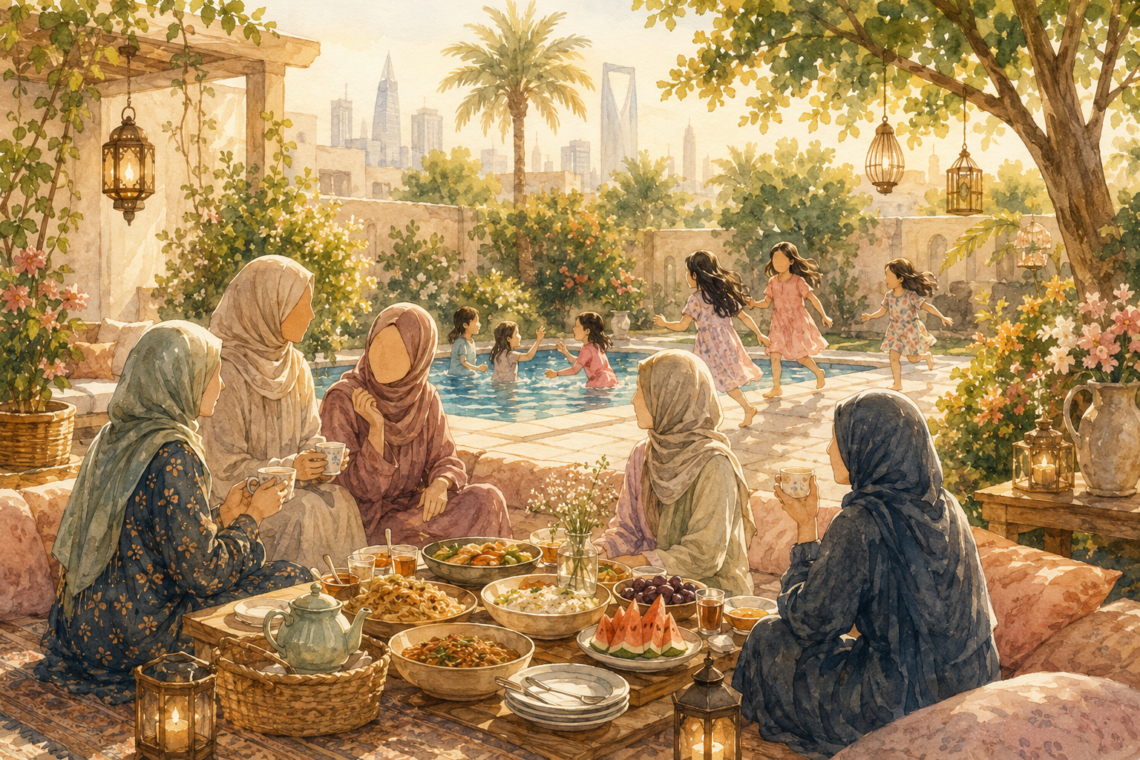
Most weekends, a group of mothers would gather with our children. Sometimes it was Indonesian friends. Sometimes it was a beautiful mix of women from different countries, all raising families far from home. The men were usually much harder to gather, so it became our little world.
Someone brought fried noodles. Someone else arrived with curry, sambal, fruit, or dessert. The tables slowly filled with dishes from different kitchens, different countries, and different childhoods. Nobody wondered whether the menu matched. It always somehow worked.
The children hardly waited for us to finish unloading the food. Swimming bags were dropped by the door. Little feet raced toward the pool. The older children disappeared into games of their own, while the younger ones proudly showed off how much braver they had become in the water since the last gathering.
One by one, we slipped out of our abayas. Beautiful dresses appeared. Comfortable clothes. Hair that had been tucked away all week could finally be uncovered among sisters. For a few precious hours, we didn’t have to think about adjusting our hijabs, wondering who might arrive, or feeling self-conscious.
We could just be.
Be women.
Mothers.
Friends.
Sisters.
We laughed. Sometimes someone shared a funny story that left us wiping tears from our eyes. Sometimes we reminisced about home. Sometimes we swapped recipes, talked about homeschooling, pregnancies, raising teenagers, or simply wondered what to cook for dinner tomorrow. The conversations wandered without an agenda. Nobody was in a hurry to reach a conclusion.
The tea kept being refilled. Someone quietly cut watermelon. Someone else’s toddler wandered into another mother’s lap without anyone thinking twice. One of the older children naturally began organizing games for the younger ones.
Nobody asked whose child was whose before helping. If someone needed to pray, another mother instinctively kept an eye on the children. If a little one wandered into the wrong lap, nobody hurried to move them back.
Care was shared.
Looking back, I realize our children weren’t just growing up with friends.
They were growing up surrounded by aunties.
Women who gently corrected them. Cheered for them. Fed them. Made du’a for them. Loved them simply because they belonged to all of us.
Somehow, everyone belonged to everyone.
While we were talking, childhood was happening. Friendships were forming. Confidence was growing. Little disagreements were being solved. Someone learned to float without holding the edge of the pool. Someone else finally became brave enough to jump in.
None of it had been planned.
It simply happened because we stayed long enough for life to unfold.
Looking back now, I wonder if that is what I miss most.
Not Riyadh itself.
Not even the istiraha.
But the permission to linger.
Life today often feels carefully scheduled. Coffee at ten. Leave by eleven. Another errand. Another appointment. Another notification. We spend weeks arranging an hour together, then spend half of it checking the time.
Perhaps that is why those afternoons feel so precious in my memory. Not because they were extraordinary. Quite the opposite. They were wonderfully ordinary.
Just women. Children. Potluck food. Tea that never seemed to run out. Laughter echoing across the garden. A little girl twirling in a pretty dress because there were only sisters around to admire it. A mother finally sitting down after chasing toddlers all morning.
A friend saying, “Stay a little longer.”
And nobody needing an excuse to do exactly that.
The children never asked when it was time to go home because they secretly hoped the answer would be,
“Not yet.”
I don’t know if I’ll ever live in Riyadh again.
But I find myself wondering whether the thing I truly miss can be recreated anywhere.
Not the building.
Not the swimming pool.
Not even the city.
Just a place where women gather without rushing. Where children grow up together one weekend at a time. Where hospitality is measured less by perfect tables and more by open hearts. Where nobody feels like a guest. Where the afternoon is allowed to become evening. Where conversations aren’t interrupted because the clock says they should end.
Perhaps home is not only where we were born.
Perhaps it is where we are given permission to linger.
Where the afternoon is allowed to become evening.
Where children don’t notice the sun beginning to set.
Where another pot of tea quietly appears.
Where nobody reaches for their keys simply because the clock says it’s time.
Perhaps that was never really about Riyadh.
Perhaps it was always about community.
And perhaps, by Allah’s mercy, it is something we can begin building again.
One unhurried afternoon at a time.


You May Also Like

One Full Trolley

The Inner Thoughts of a Perimenopausal Woman